
On a July 2026 afternoon game drive out of Kwando Safari’s Splash Camp, we got a radio call letting us know that another Kwando safari vehicle had located African wild dogs. Splash Camp is located in the north of the Okavango Delta, and their game drive area is frequented by one or two packs of wild dogs some of the time. We had been searching for them this time, but without any success until we got the radio call. We drove directly to the location and Setlhako Twimone, our expert guide positioned the Toyota Landcruiser in a good place to take in the action. A pack of eight African wild dogs had chased and almost caught a male impala. To avoid capture, the male impala had run straight into a large pool of water, set about by mature woodland.
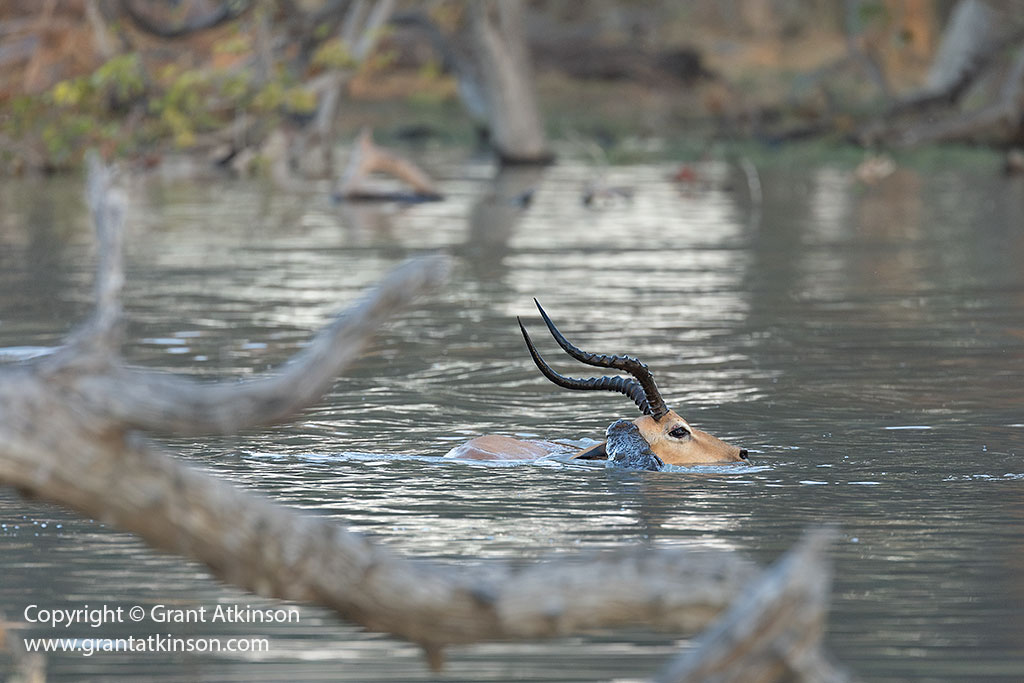
Botswana. Impala and Nile crocodile. Shutter speed 1/1000sec at f7,1, iso 6400. Focal length 500mm. R1 and RF 100-500L f4.5-7.1 IS. Time 17h48:09. Click for larger view
Unfortunately for the impala, a Nile crocodile that was already in the water body, had grabbed hold of him. It is not an uncommon occurrence for antelope like impala and kudu to enter deep water to escape being pursued by wild dogs in this part of Botswana and sometimes it can work if the wild dogs fear being attacked by a crocodile themselves too much and are unwilling to enter into the water. Wild dogs are actually good swimmers themselves and I have seen them catch up to swimming impala in deep water when there are no crocodiles. This was not one of those times. The crocodile had clamped it’s jaws onto the poor impala’s ear. The water was just deep enough that the impala was able to touch the bottom with it’s feet and it was resisting the crocodile. The crocodile was only of a medium size itself and it was having difficulty pulling the impala under.
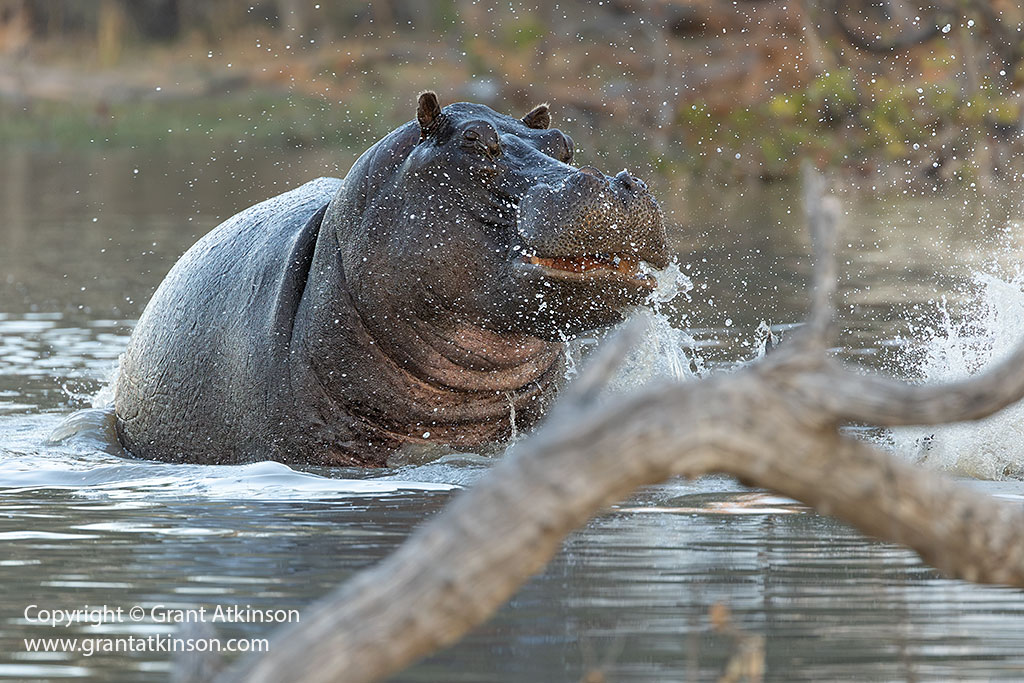
Botswana. Hippopotamus and crocodile splash. Shutter speed 1/1000sec at f7,1, iso 5000. Focal length 500mm. R1 and RF 100-500L f4.5-7.1 IS. Time 17h48:19. Click for larger view
The pool of water was also home to a hippo. We watched as that hippo very quickly took an interest in the impala’s struggle. The hippo approached the impala from behind, with purpose. There are instances of hippo gently pushing injured impala out of the water and then, still other instances of hippo biting to death any impala that might be swimming in the hippo’s pool. We did not know which of these two hippo behaviours we where about to witness. As the hippo got closer and closer, the crocodile kicked up a tremendous splash, with more water thrown into the air than I could have imagined. This seemed to startle the hippo and caused it some uncertainty as to what it was dealing with. The water was greenish and opaque, so the parts of the crocodile that where underwater could not be easily seen. The hippo made a very fast about-turn away from both creatures. and moved quickly back to the deepest part of the pool.
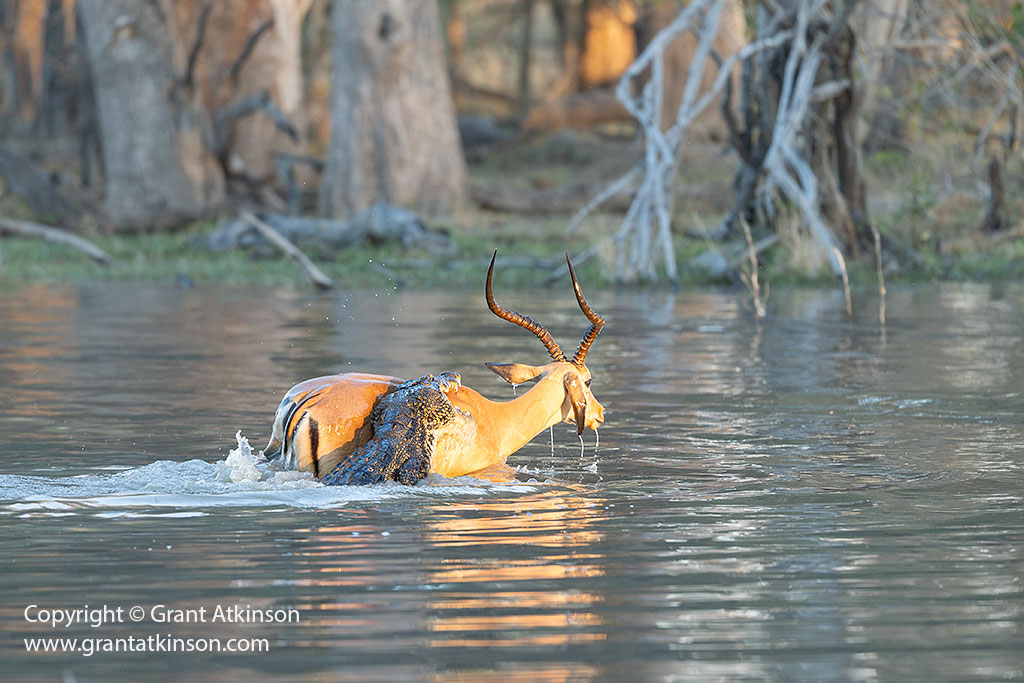
Botswana. Impala and Nile crocodile. Shutter speed 1/1000sec at f5,6, iso 5000. Focal length 363mm. R1 and RF 100-500L f4.5-7.1 IS. Time 17h48:28. Click for larger view
Now there seemed nothing that could save the impala. The impala did not give up though and kept trying to stay on his feet.
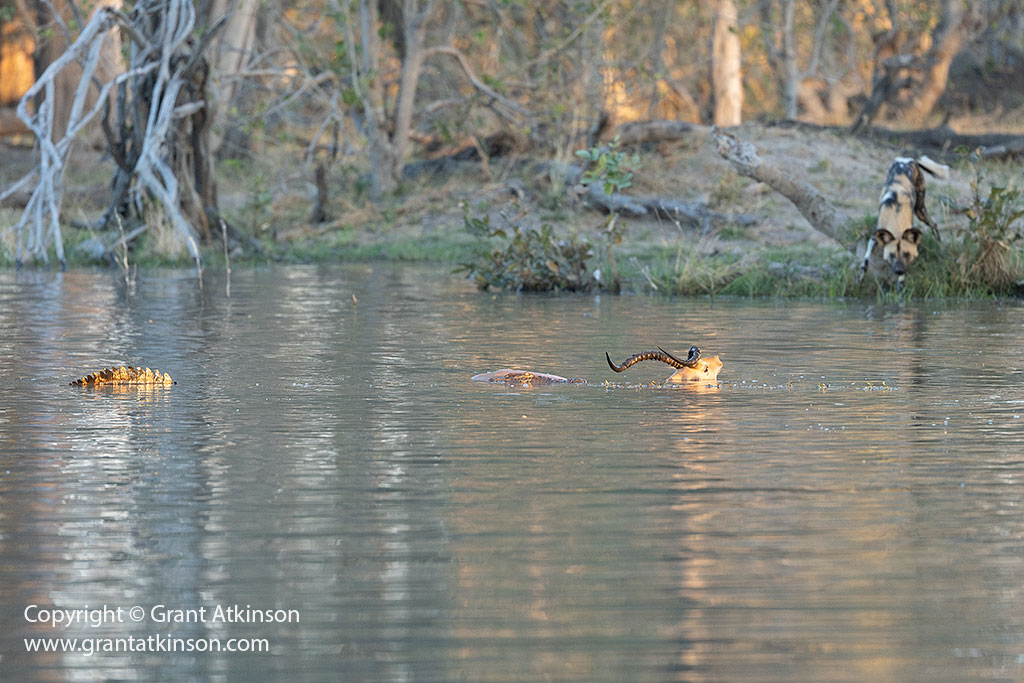
Botswana. Nile crocodile holding the impala while the African wild dog watches. Shutter speed 1/1250sec at f5,6, iso 6400. Focal length 343mm. R1 and RF 100-500L f4.5-7.1 IS. Time 17h49:18. Click for larger view
In the shallower parts of the pool, he was able to slowly move toward the side, taking the crocodile with him. One of the wild dogs made his way excitedly to the water’s edge, directly where the impala was headed to.
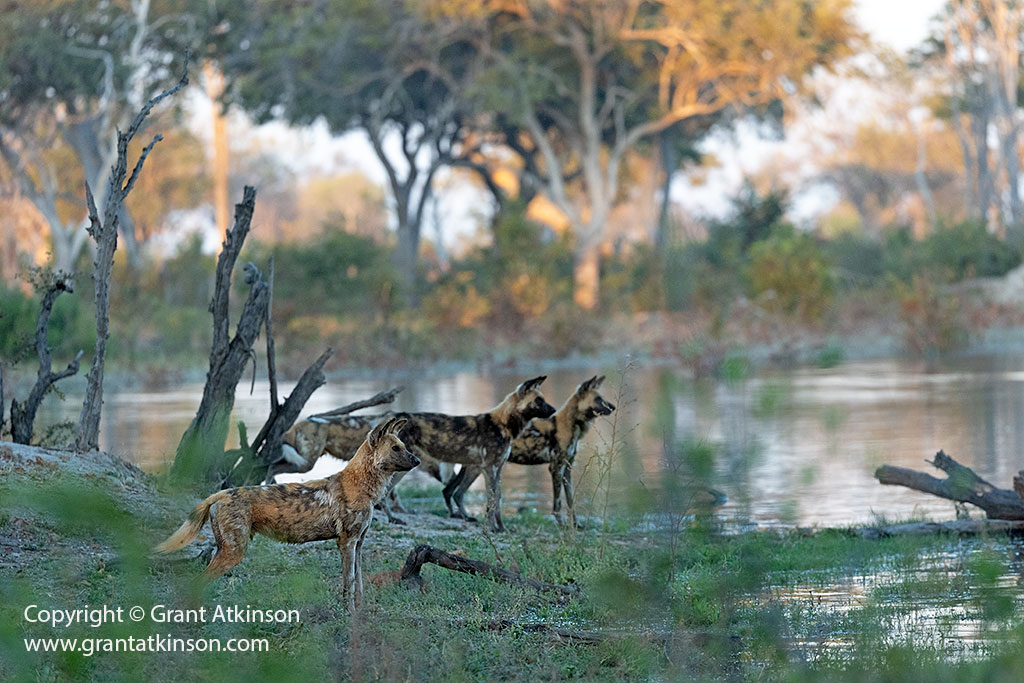
Botswana. Pack members watching the impala. Shutter speed 1/800sec at f6,3, iso 3200. Focal length 363mm. R1 and RF 100-500L f4.5-7.1 IS. Time 17h53:50 Click for larger view
The other seven wild dogs where still watching the struggle with intent from various positions around the pool’s edge. Usually, struggles like this are very short-lived, but the impala was strong, and it was fighting for it’s life. At the same time, the crocodile was not large enough itself to easily pull the impala under the water, and so they continued.
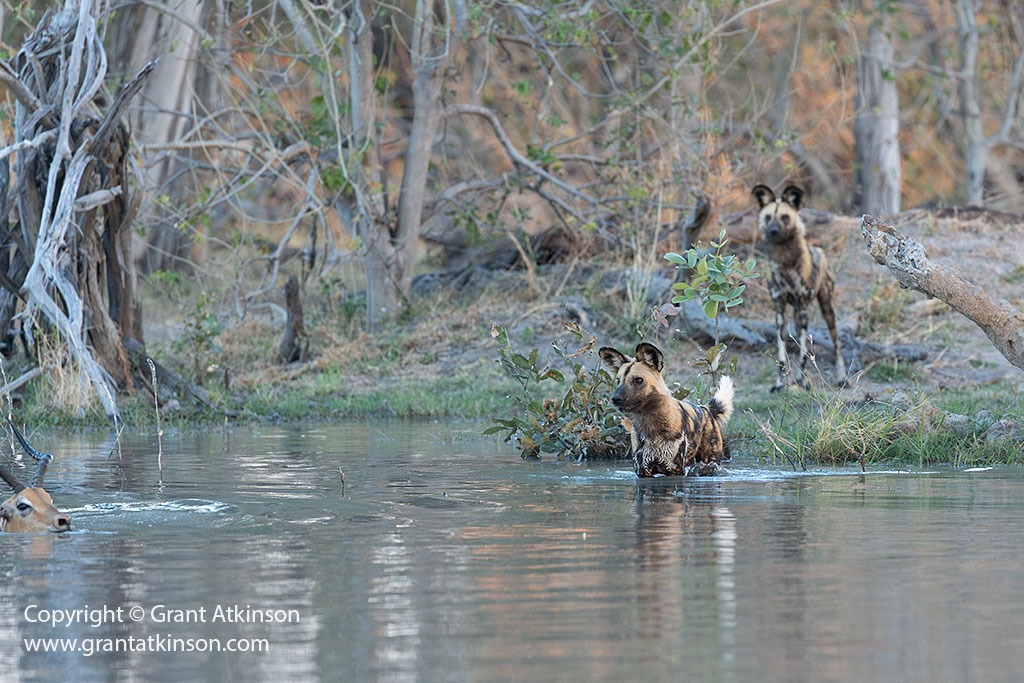
Botswana. A male dog enters the water. Shutter speed 1/800sec at f7,1, iso 10000. Focal length 500mm. R1 and RF 100-500L f4.5-7.1 IS. Time 17h56:54 Click for larger view
One of the male wild dogs was extremely focused on the impala, even more so than the rest of his pack. He even entered the water, right up to his belly when the impala started getting closer to the side. This caused the impala to turn away and change direction, which was counter to the wild dog’s plan.
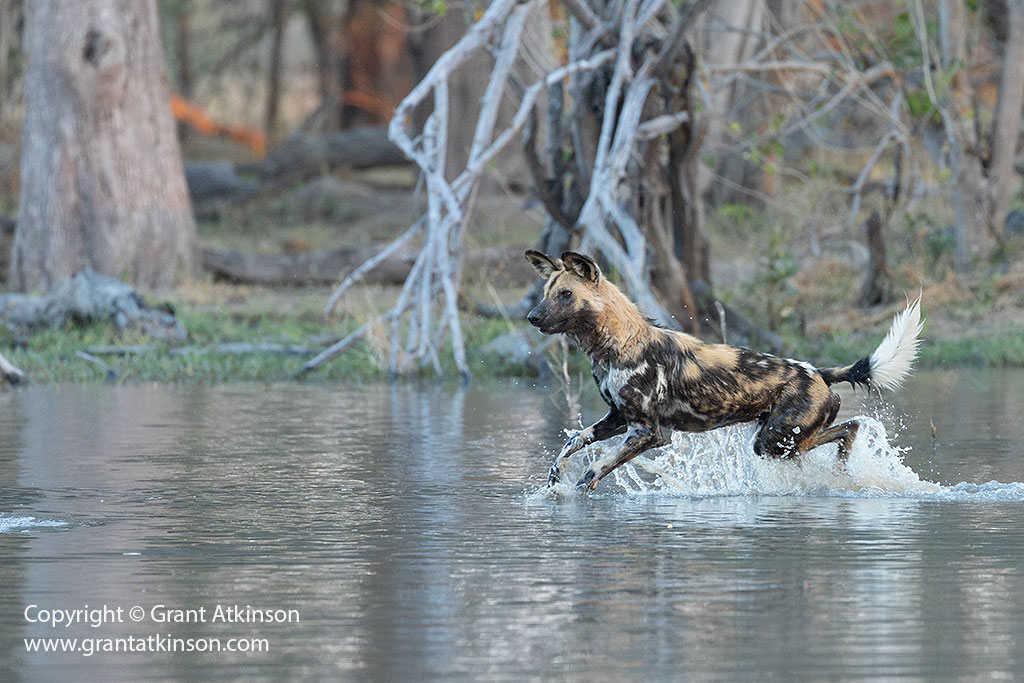
Botswana. Male wild dog leaps toward the impala and crocodile. Shutter speed 1/800sec at f7,1, iso 10000. Focal length 500mm. R1 and RF 100-500L f4.5-7.1 IS. Time 17h57:56 Click for larger view
The male wild dog then jumped deeper into the water, and further from the side, as he was intent on getting the impala, which still had the crocodile hanging onto it. The impala chose the deeper water though and the wild dog turned back and splashed out of the water.

Botswana. Determined wild dog watching the impala. Shutter speed 1/640sec at f7,1, iso 5000. Focal length 500mm. R1 and RF 100-500L f4.5-7.1 IS. Time 18h00:59 Click for larger view
The same male wild dog ran around one end of the pool, ears pricked forward and tail up, with his focus still on the impala. Now on the complete opposite side of the pool, he tried to reach the impala by making his way onto a fallen tree trunk. This allowed him to get further out into the water but still not close enough.
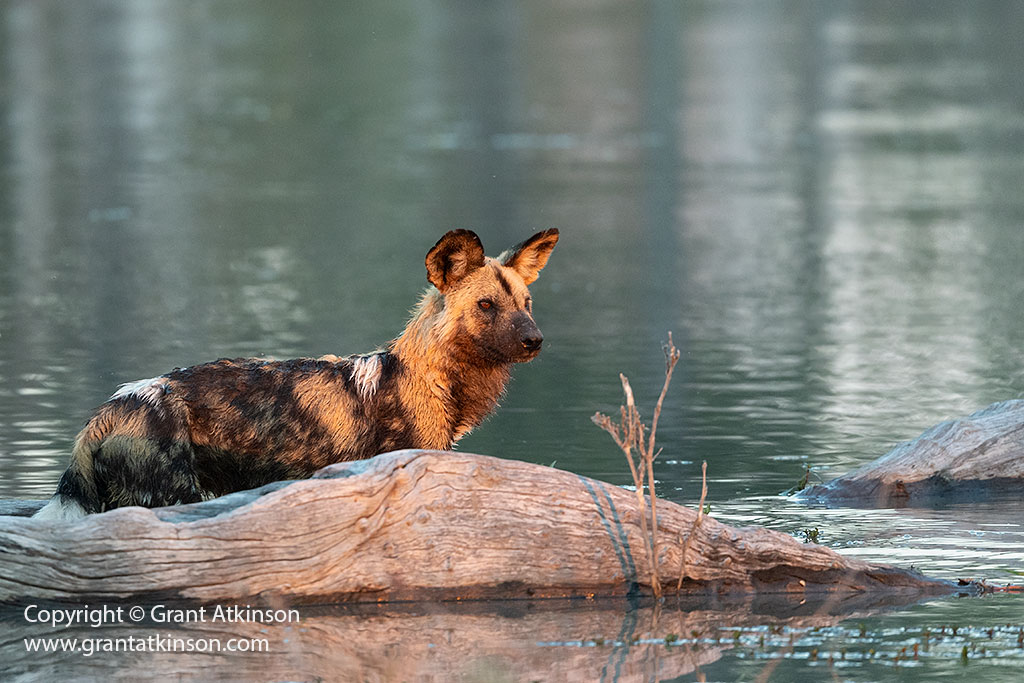
Botswana. The same male wild dog uses a different fallen tree to try to reach the impala. Shutter speed 1/640sec at f6,3, iso 5000. Focal length 400mm. R1 and RF 100-500L f4.5-7.1 IS. Time 18h01:33 Click for larger view
When the impala changed direction yet again, the male wild dog found another fallen tree trunk and he climbed out on it but again, he was unable to get near and he jumped back off the log.
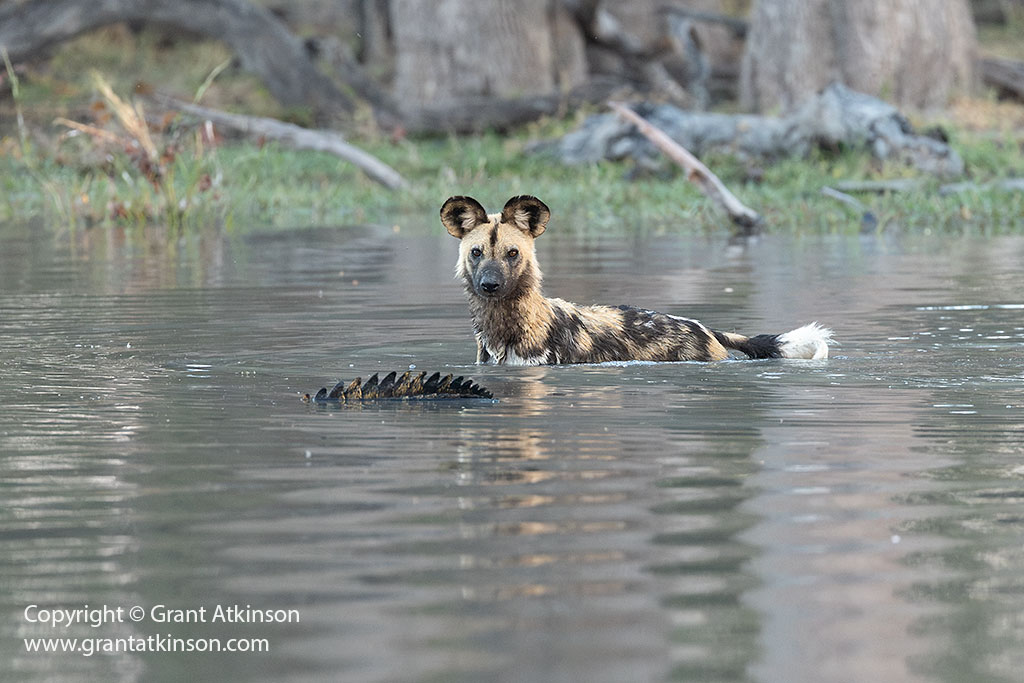
Botswana. Brave wild dog and nile crocodile. Shutter speed 1/320sec at f7,1, iso 8000. Focal length 500mm. R1 and RF 100-500L f4.5-7.1 IS. Time 18h02:52 Click for larger view
After all the direction changes, the impala had once again ended up on the shallower side of the pool. The same male wild dog raced around the pool one more time, in order to get close to the impala. This time, he boldly re-entered the water, and bravely waded out until he was almost able to touch the crocodiles tail. For several minutes, he watched it closely, and we even wondered briefly if he was thinking about nipping the croc’s tail to scare it but he never did. He did splash around a bit but even that did not cause the crocodile to let the impala go.

Botswana. Wild dog watching the tail of the crocodile still holding the impala by it’s back leg. Shutter speed 1/320sec at f6,3, iso 6400. Focal length 324mm. R1 and RF 100-500L f4.5-7.1 IS. Time 18h03:19 Click for larger view
This most determined and brave wild dog just stayed in the water up to his chest for minute after minute. Even though the danger was perhaps less from the crocodile that was holding the impala, there could have been other crocodiles in the pool. The dog did not care, and he wanted the dog pack’s impala back!
We took our last picture of the impala at 18h19 and the crocodile was still holding on, which meant that the impala had been resisting for more than half an hour. The brave male wild dog had given up on trying to scare the crocodile and had made his way safely out of the water, much to our relief. The dogs still waited, even though some of them moved a short distance away from the water. It had become too dark for photography.
Soon after, in the early darkness, the crocodile did let go of the impala and it walked out of the water, only for the dogs to kill it and eat it, very quickly. They got lucky. We felt deeply sorry for the unfortunate male impala, especially given how long he struggled with the crocodile. At the same time, we were glad that the wild dogs managed to get their meal that they had worked hard for.
Those who know me well will know that African wild dogs are a favourite animal of mine. They pay me back and win new fans for themselves with sightings like this one. It was the wild dogs and their afternoon hunt that ended up starting an interaction between three species of mammals and one reptile! The brave male wild dog exhibited a degree of fearlessness that was new to me and that he did not get harmed by that crocodile or an unseen one, made me very happy. Over time, I have been able to photograph and record on this website African wild dogs at play, also hunting large prey, and interacting with spotted hyaena, and then even two packs fighting over territory. All my best sightings have come from the northern Botswana population, with the Okavango Delta and connected, protected land around the Kwando River, Linyanti River, Savuti Channel and Chobe River being most important for the wild dogs.

Incredible trifecta viewing, great photos, and story telling. Wish I had been there! Thanks for sharing Grant.
Thanks for reading Claire, I was happy I could get photos of the action, so often wild dogs go so fast through the woodland that we cannot keep up, at least this time they stopped when the impala stopped! The photos enabled me to share the story in a better way! Thanks for commenting here.
Wow, Grant, what an incredible sighting! I am so glad you were there to see it all! Great shots you got too!
Thanks for reading and looking Darlene. We ran out of light before the sighting ended but it was an exciting one. All the safari vehicles from Splash Camp where in the sighting and that evening at dinner, everybody was so excited about watching it all happen 🙂
We have been at Splash camp and seen wild dogs make a kill in the staff/maintenance area. I appreciate how you told this story. One question, does Kwando not use a spotlight on wild dogs at night? I have been with them many times and they have used a spotlight on lions and leopards at night, but have never seen wild dogs at a time when the light is gone.
Hi Mark, thanks for your comment. Usually most of the safari companies will not use a spotlight on animals that are active during the day and that would include wild dogs and cheetah. Regardless of the company, i won’t use a spotlight on wild dogs specially where there are lions and hyaenas to compete with them. I am happy to stop photographing them when the natural ambient light is gone 🙂
Thanks for the clarification. Now that I think about it, in over 20 years and hundreds of nights on safari, I’ve never seen wild dogs or cheetahs at night so the issue has never come up. You are certainly right about protecting these endangered species.